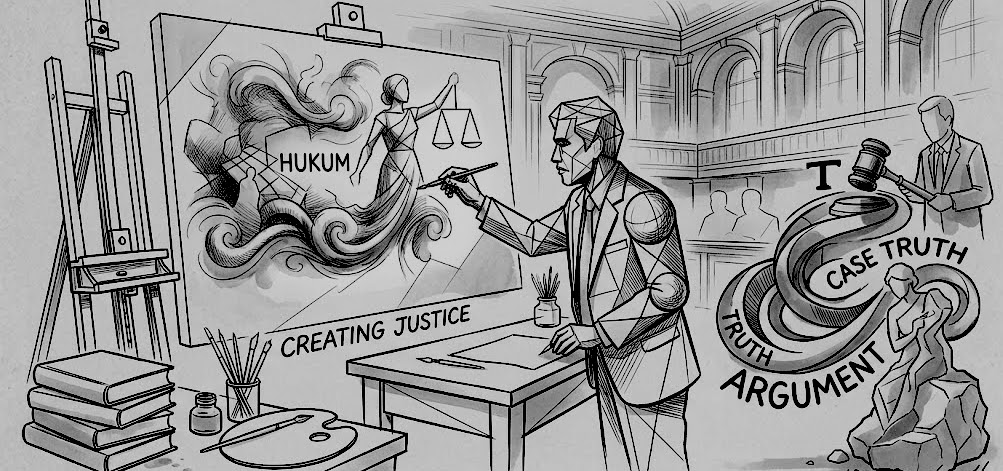
In the quiet, dusty libraries of legal academia, law is often taught as a set of rigid instructions — a “DNA” of society that dictates every movement. But as we watch the unfolding drama of Indonesian scholars facing accusations of treason (makar) for discussing ways to step down a president that aren’t explicitly written in the “DNA” of the constitution, it’s time to call the “DNA” theory what it is: a creative dead end.
To understand why the jurist lawyer is an artist and the law is a masterpiece in progress, we have to look toward a revolutionary of a different kind: the French composer Claude Debussy.
The Ancient Canvas: Ars Boni et Aequi
Long before the modern state attempted to turn the law into a cold, bureaucratic machine, the Roman jurist Celsus provided the ultimate definition of our craft: “Jus est ars boni et aequi.” (Law is the art of the good and the equitable.) The Romans didn’t call law a science or a rigid code; they called it an ars — a craft, a skill, and an art form. It was never meant to be a static set of rules to be followed blindly. Instead, it was an active practice of sculpting “the good” and “the fair” out of the messy reality of human conflict.
This ancient wisdom finds its modern echo in the Debussy Doctrine. Claude Debussy famously upended the musical world by declaring: “Works of art make rules; rules do not make works of art.” For Debussy, music didn’t come from a textbook on harmony. The masterpiece came first — born from emotion, atmosphere, and the “impression” of the moment — and only afterwards did critics write down the rules of why it worked.
The State, however, has it backwards. Our current legal system treats the Constitution like a “DNA” sequence. They believe that if you follow the code (the rules), you automatically get a functioning society. But just as following a music theory book won’t make you a genius composer, following a rigid legal code doesn’t guarantee justice. If the “DNA” of the law is disconnected from the “Soul” of the people, the music stops.
The Lawyer as the “Avant-Garde” Artist
When we apply this radical and beautiful doctrine, the lawyer’s role changes. They are no longer a technician repairman for the State’s machine; they are an artist. Under this lens, a lawyer doesn’t just “read” the law. They compose with it. They look at the “canvas” of Indonesian society — riddled with the wounds of systemic injustice, the catastrophic malfunction of the rule of law, and the suffocating concentration of power within a militaristic regime — and realize that the old rules are no longer creating a beautiful picture. The lawyer changes from legalist to truly jurist.
The lawyer-artist as truly jurist operates through a specialized creative process that transforms legal conflict into a masterpiece of social change. By introducing harmonic dissonance, they expose the jarring contradictions where static state regulations clash with the fundamental resonance of human rights. When the gears of the constitutional machine seize up, they employ creative improvisation to compose “off-script” pathways, navigating the spaces beyond formal boundaries to resolve systemic paralysis. Ultimately, they apply an aesthetic perspective that shifts the national gaze away from the narrow, technical ink of the written code and toward the broader, more vibrant landscape of moral truth and ethical necessity. Shifting the view from “what is written” to “what is right.”
The “Treason” of a New Masterpiece
In the current Indonesian discourse regarding the Muzani case, the State’s reaction mirrors that of a dogmatic, old-fashioned music teacher screaming “Heresy!” simply because a student dared to play a chord not found in an 18th-century handbook. By branding the movement as Makar (treason), the authorities are attempting to enforce a rigid, “DNA-based” obedience to the formal rules of the past, viewing any deviation as mere destruction. However, through a Debussyan lens, this tension reveals a deeper reality: what the State calls destruction is actually an act of political Creation. It is the birth of a new social symphony that refuses to be stifled by stagnant codes, asserting that the “masterpiece” of a nation’s collective will must ultimately dictate the rules, rather than being silenced by them.
When scholars -like Muzani -talk about stepping down a leader “beyond the law,” they are arguing that the Work of Art (the Nation) is more important than the Rule (the Constitution). If a leader has lost the “harmony” of the people, the scholars are simply trying to compose a new movement for the country. They are looking for a “Social Impressionism” where the legitimacy of power is felt in the gut, not just found in a paragraph of a decree.
Beyond the Frame: The Extra-Constitutional Exit
Legal anarchism suggests that the ultimate power doesn’t live in a building in Jakarta; it lives in the shared imagination of the citizens. If the current “DNA” of our laws is producing a society that feels like a broken record, the lawyer-artist has a duty to look beyond the frame. Stepping down a president through social pressure, moral withdrawal, or collective “swasembada” (self-reliance) isn’t an act of chaos — it is the birth of a new rule.
The takeaway? We must stop treating our Constitution as a sacred, unchangeable code. It is merely the program notes for a performance. When the performance no longer moves the audience, it’s time for the artists — the scholars, the lawyers, and the people — to write a new score.
After all, if we only follow the DNA, we’ll never create a masterpiece.
@2026 | NH

